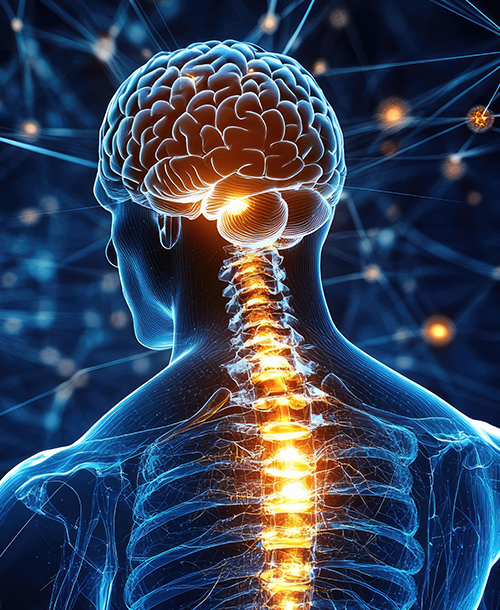
The Brain-Based Model of Chiropractic Care
Chiropractic adjustments stimulate spinal proprioceptors, sending signals to the brain that recalibrate neural processing and improve regulation across multiple body systems.
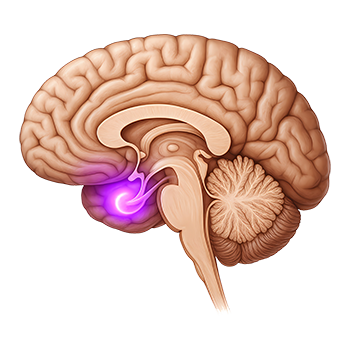
The brain-based model of chiropractic care proposes that chiropractic adjustments work by stretching specific dysfunctional spinal tissues, triggering a powerful proprioceptive signal to the brain that can recalibrate neural processing and improve overall function.1 This model represents an evolving, neuroscience-informed framework based on over two decades of research into the effects of chiropractic care on brain function and human performance.1-7 In this model, the spine is not viewed simply as a mechanical structure, but as a critical sensory organ.8 The deep muscles and joints of the spine are densely packed with proprioceptive receptors that continuously inform the brain about body position, movement, and segmental spinal function.9-11 This incoming information is essential for the brain to maintain an accurate internal representation of the body, often referred to as the body schema, and to integrate this with information from the external environment (i.e. impacting our brains external world schema).11-14
When spinal segments become dysfunctional, what chiropractors describe as vertebral subluxation, the quality and fidelity of this proprioceptive input can change.1,4,7 Instead of delivering clear, accurate signals, the input may become altered or less reliable.1,4,7 There are at least three reasons that spinal segments can become dysfunctional: physical injury, psychological stress, and local inflammation.1 All of these situations are capable of neurologically inhibiting the small deep paraspinal muscles, setting up a self-perpetuating central segmental motor control problem.1,5
This has important consequences for how the brain processes information. We know the brain creates its own narrative about what is happening inside us and in the world around us.15 Within this predictive processing framework, the brain constantly generates predictions about the body and the world and updates those predictions based on incoming sensory input when mismatches occur.16-18 If that input is degraded, the brain’s predictions can become less accurate, prediction error signalling can be disrupted, and the system may shift toward more rigid, less adaptable patterns of function.16-19
These changes extend beyond local spinal processing and influence large-scale brain networks.4 In particular, networks such as the default mode network, which is involved in internal self-referential processing, the salience network, which detects and prioritises relevant information, and the central executive network, which supports attention and goal-directed behaviour, can all be affected.4,20 Altered input from the spine can disrupt how these networks communicate and switch between states, influencing how the brain allocates attention, balances internal and external focus, and regulates physiological responses. 4,20 Over time, this may contribute to persistent symptoms, altered perception including pain, and reduced adaptability across physical, cognitive, autonomic, immune, and emotional domains. 4,20
Within this framework, the chiropractic adjustment is understood as a targeted neural intervention. By rapidly stretching specific spinal tissues, the adjustment activates mechanoreceptors in deep paraspinal structures and delivers a strong, highly salient burst of proprioceptive input to the central nervous system.21,22 The adjustment is not just input; it is a salient, attention-capturing signal that the brain prioritises for updating its internal models. This signal reaches spinal, cerebellar, and cortical circuits and, within a predictive processing framework, is likely to function as a meaningful update signal that could enable recalibration of existing neural models and internal representations.1,4,7 In effect, the brain is provided with new, high-quality information from the spine, which represents the core of the body, that can help refine and reset its internal representations of the body and improve how it predicts and responds to the environment.
Following an adjustment, a range of neurophysiological changes have been observed. These include alterations in sensorimotor integration, changes in cortical excitability, motor control and shifts in brain network connectivity, including within networks involved in self-processing, attention, cognition, and emotional regulation.1,4,7,20,23-30 There is also evidence of changes in autonomic, neuroendocrine, and immunological regulation.2,6 Together, these changes can support improvements in movement control, postural stability, cognitive function, emotional regulation, autonomic balance, endocrine and immunological regulation, and the perception of pain and other bodily states. Rather than acting on a single symptom or system, the adjustment appears to influence the way the brain integrates and responds to information more broadly. In this way, it is more accurately viewed as producing a widespread physiological response, similar to exercise.
Because the brain plays a central role in regulating multiple physiological systems, these neural changes extend well beyond the musculoskeletal system. Emerging evidence suggests effects on neuroimmune interactions, stress physiology, mental health and processes related to recovery such as sleep.1,2,4,6,20,23 This supports a broader view of chiropractic care as influencing the body through central regulatory mechanisms, while being initiated by precise mechanical input to spinal tissues.
The brain relies heavily on incoming sensory information from the body to construct and continually update its internal models of both the body and the external environment.13,31,32Emerging evidence suggests that sensory information from the spine may play a particularly important role in this process because of the spine’s central neurological role, the exceptionally rich proprioceptive input arising from deep spinal tissues,9-11 and the widespread neurophysiological changes observed following chiropractic adjustments.2,4
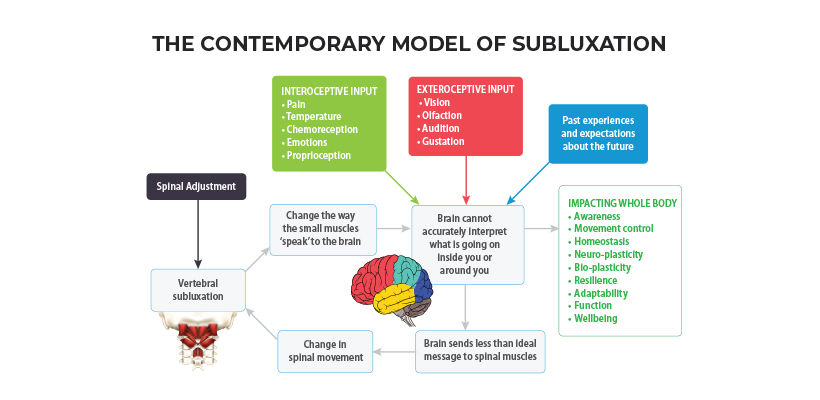
Within this broader framework, spinal function may represent part of a foundational neurological system that helps the brain regulate and coordinate many other aspects of human function and wellbeing (see Figure 1 below). If the quality of incoming sensory information from the spine becomes altered, the brain’s ability to accurately regulate and adapt multiple physiological systems may also become compromised. A growing body of research demonstrating widespread neurophysiological, autonomic, neuroendocrine, and neuroimmune changes following chiropractic care raises the possibility that altered spinal function may have much broader consequences for brain and body regulation than previously appreciated. 1,2,4,6,20,23From this perspective, chiropractic care aligns with a whole-body, whole-person approach to health, supporting improved regulation, resilience, and the capacity of the body to adapt, repair, and maintain function over time. In this model, health is understood as the brain’s ability to accurately interpret incoming information, generate appropriate predictions, and flexibly adapt its responses.33 When this adaptive capacity is compromised, symptoms may emerge across multiple domains. Chiropractic care, therefore, aims to support health by improving the quality of sensory input from the spine, enhancing neural integration, and increasing the brain’s overall adaptability. Thus, the adjustment is not simply a mechanical correction, but a way of facilitating more optimal brain function and, in turn, more effective regulation of the body. Chiropractic adjustments appear to work by changing the information the brain receives from the body, thereby resetting neural processing and internal representations, and improving self-awareness, self-regulation, and the ability to adapt, repair, and heal.

by Dr Heidi Haavik
References
- Haavik, H. et al. The contemporary model of vertebral column joint dysfunction and impact of high-velocity, low-amplitude controlled vertebral thrusts on neuromuscular function. European Journal of Applied Physiology, 1-46 (2021).
- Amjad, I. et al. The effects of 12 weeks of chiropractic spinal adjustments on physiological biomarkers in adults: A pragmatic randomized controlled trial. PLoS One 20, e0338730 (2025).
- Niazi, I. K. et al. A randomized controlled trial comparing different sites of high-velocity low amplitude thrust on sensorimotor integration parameters. Sci Rep 14, 1159 (2024).
- Haavik, H. et al. Neuroplastic Responses to Chiropractic Care: Broad Impacts on Pain, Mood, Sleep, and Quality of Life. Brain Sciences 14, 1124 (2024).
- Haavik, H. in Pediatric chiropractic (ed C. A. Anrig and G. Plaugher) (Lippincott Williams & Wilkins, 2022).
- Haavik, H. et al. The Potential Mechanisms of High-Velocity, Low-Amplitude, Controlled Vertebral Thrusts on Neuroimmune Function: A Narrative Review. Medicina 57, 536 (2021).
- Haavik, H. & Murphy, B. The role of spinal manipulation in addressing disordered sensorimotor integration and altered motor control. J Electromyogr Kinesiol 22, 768-776, doi:10.1016/j.jelekin.2012.02.012 (2012).
- Brumagne, S., Cordo, P., Lysens, R., Verschueren, S. & Swinnen, S. The Role of Paraspinal Muscle Spindles in Lumbosacral Position Sense in Individuals With and Without Low Back Pain. SPINE 25, 989-994 (2000).
- Kulkarni, V., Chandy, M. J. & Babu, K. S. Quantitative study of muscle spindles in suboccipital muscles of human foetuses. Neurol India 49, 355-359 (2001).
- Blecher, R. et al. New functions for the proprioceptive system in skeletal biology. Philosophical Transactions of the Royal Society B: Biological Sciences 373 (2018).
- Pettorossi, V. E. & Schieppati, M. Neck proprioception shapes body orientation and perception of motion. Frontiers in human neuroscience 8, 895 (2014).
- Cardinali, L., Brozzoli, C., Luauté, J., Roy, A. C. & Farnè, A. Proprioception is necessary for body schema plasticity: evidence from a deafferented patient. Frontiers in Human Neuroscience 10, 272 (2016).
- Maravita, A., Spence, C. & Driver, J. Multisensory integration and the body schema: close to hand and within reach. Curr. Biol. 13, R531-R539 (2003).
- Proske, U. & Gandevia, S. C. The proprioceptive senses: their roles in signaling body shape, body position and movement, and muscle force. Physiological reviews 92, 1651-1697 (2012).
- Menon, V. 20 years of the default mode network: A review and synthesis. Neuron (2023).
- Sprevak, M. & Smith, R. An Introduction to Predictive Processing Models of Perception and Decision-Making. Top Cogn Sci, doi:10.1111/tops.12704 (2023).
- Picard, F. & Friston, K. Predictions, perception, and a sense of self. Neurology 83, 1112-1118, doi:10.1212/wnl.0000000000000798 (2014).
- Hogendoorn, H. Perception in real-time: predicting the present, reconstructing the past. Trends in Cognitive Sciences 26, 128-141 (2022).
- Bray, H. & Moseley, G. L. Disrupted working body schema of the trunk in people with back pain. British Journal of Sports Medicine 45, 168-173 (2011).
- Waterstone, T. S. et al. Functional connectivity analysis on resting-state electroencephalography signals following chiropractic spinal manipulation in stroke patients. Brain Sciences 10, 644 (2020).
- Pickar, J. G. & Bolton, P. S. Spinal manipulative therapy and somatosensory activation. J Electromyogr Kinesiol 22, 785-794, doi:10.1016/j.jelekin.2012.01.015 (2012).
- Pickar, J. G. Neurophysiological effects of spinal manipulation. Spine Journal 2, 357-371, doi:10.1016/S1529-9430(02)00400-X (2002).
- Holt, K. et al. The Effects of 4 Weeks of Chiropractic Spinal Adjustments on Motor Function in People with Stroke: A Randomized Controlled Trial. Brain Sciences 11, 676 (2021).
- Navid, M. S. et al. Investigating the Effects of Chiropractic Spinal Manipulation on EEG in Stroke Patients. Brain Sciences 10, 253 (2020).
- Kingett, M. et al. Increased voluntary activation of the elbow flexors following a single session of spinal manipulation in a subclinical neck pain population. Brain Sciences 9, 136 (2019).
- Holt, K. et al. The effects of a single session of chiropractic care on strength, cortical drive, and spinal excitability in stroke patients. Sci Rep 9, 2673 (2019).
- Haavik, H. et al. Chiropractic Manipulation Increases Maximal Bite Force in Healthy Individuals. Brain Sci 8, doi:10.3390/brainsci8050076 (2018).
- Christiansen, T. L. et al. The effects of a single session of spinal manipulation on strength and cortical drive in athletes. Eur J Appl Physiol 118, 737-749, doi:10.1007/s00421-018-3799-x (2018).
- Niazi, I. K. et al. Changes in H-reflex and V-waves following spinal manipulation. Exp Brain Res, doi:10.1007/s00221-014-4193-5 (2015).
- 30 Niazi, I. K. et al. The Effect of Spinal Manipulation on the Electrophysiological and Metabolic Properties of the Tibialis Anterior Muscle. Healthcare 8, doi:10.3390/healthcare8040548 (2020).
- de Vignemont, F., Pitron, V. & Alsmith, A. J. What is the body schema. Body schema and body image: New directions, 3-17 (2021).
- Holmes, N. P. & Spence, C. The body schema and the multisensory representation(s) of peripersonal space. Cogn Process 5, 94-105, doi:10.1007/s10339-004-0013-3 (2004).
- Koban, L., Gianaros, P. J., Kober, H. & Wager, T. D. The self in context: brain systems linking mental and physical health. Nature Reviews Neuroscience 22, 309-322 (2021).